


Few concepts in modern leadership are invoked as often - and understood as little - as authenticity. “Just be yourself!” sounds nice—until you realize it’s about as easy as dancing freely while someone dictates the steps.
With AI entering our communication spaces, the tension deepens. When our words are filtered, optimized, or even generated by algorithms, we must ask: How real is what we say - when a system listens, suggests, and smooths it in the background? And how real are we when we start modelling our own impact through data?
Psychologically, two logics now coexist. One is human, relational and contextual, and sometimes contradictory; the other is algorithmic, consistent and efficient. The other is algorithmic: consistent, efficient and context-free. Leadership now exists in the space between these two worlds. It must bridge the gap not only between humans and machines, but also between authenticity and expectation.
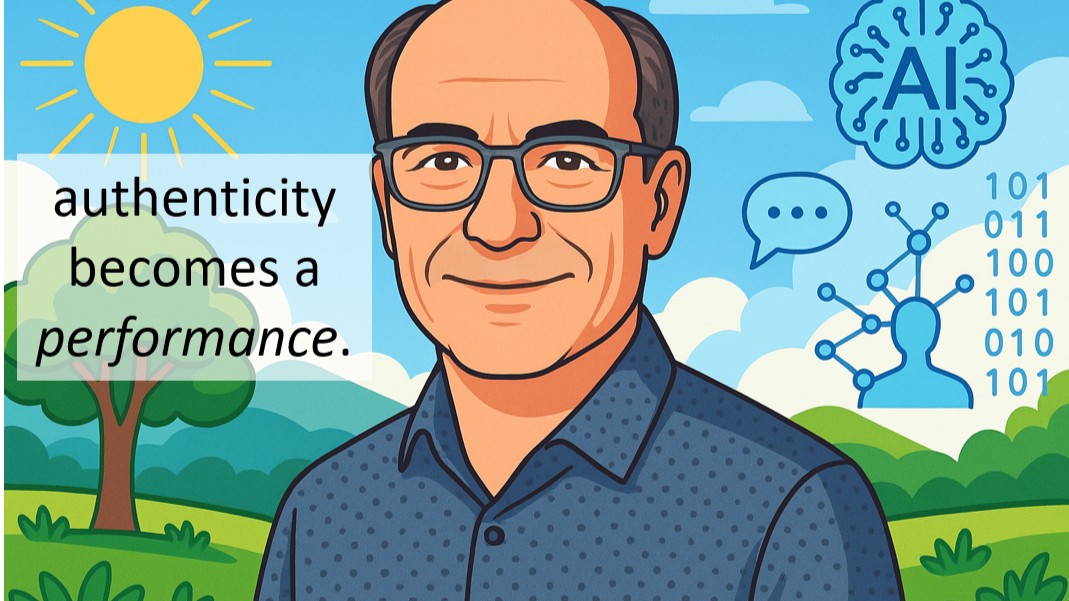
The danger is subtle: authenticity becomes a performance. A carefully curated “realness”, guided by feedback loops, likes, and algorithmic metrics. It’s no longer authenticity, but an emotional interface - professional, polished, yet somehow untouched.
And yet, in an age of digital mediation, the desire for genuine human connection is growing. Authenticity is not the opposite of playing a role; it's about designing your role consciously. It means remaining true to yourself while performing for others. As Niklas Luhmann said, leadership requires role distance, not role collapse. Reflecting on your role doesn't make you any less real; it simply makes your identity clearer.
Paradoxically, AI can help in this situation. It mirrors our automated reactions and reveals where patterns replace presence and professionalism becomes a façade. However, AI knows no authenticity - it has no inner life. It can simulate what looks real, but it cannot feel what is real. This is where its educational power lies: it reminds us that emotion cannot be computed.
In the age of AI, authenticity does not mean rejecting technology; it means embracing our imperfections alongside it. Small slips, spontaneous laughter and moments of genuine uncertainty are acts of humanity in the modern age. Perhaps that is the only true competitive advantage that cannot be replicated by a system.
Leadership insight: Leading today means practicing authenticity deliberately- not as the opposite of professionalism, but as its depth. Especially in AI-mediated environments, leaders should create spaces where ambiguity, doubt, and humour can exist. Because where everything sounds perfect, people soon stop listening.
Consulting insight: Consultants can help organizations understand authentic communication not as a soft skill, but as a systemic competence. That means: designing feedback formats that allow contradictions, and using AI tools to reveal speech patterns—not to standardize them. Because the value of authenticity lies not in smoothness, but in resonance.
In a world where algorithms increasingly shape how we lead, speak, and connect, authenticity becomes an act of quiet courage. How do you stay genuine in environments where data defines perception?
I’d love to hear your thoughts - where do you draw the line between authenticity and adaptation in the age of AI?