

AI Leadership
Symbiosis (ALS)
Leadership in the age of intelligent systems – conscious, ethical and effective.
The rapid development of AI is changing how we work, make decisions and take responsibility. However, technology alone does not create better leadership. The decisive factor is the attitude with which we approach it.
What means ALS?
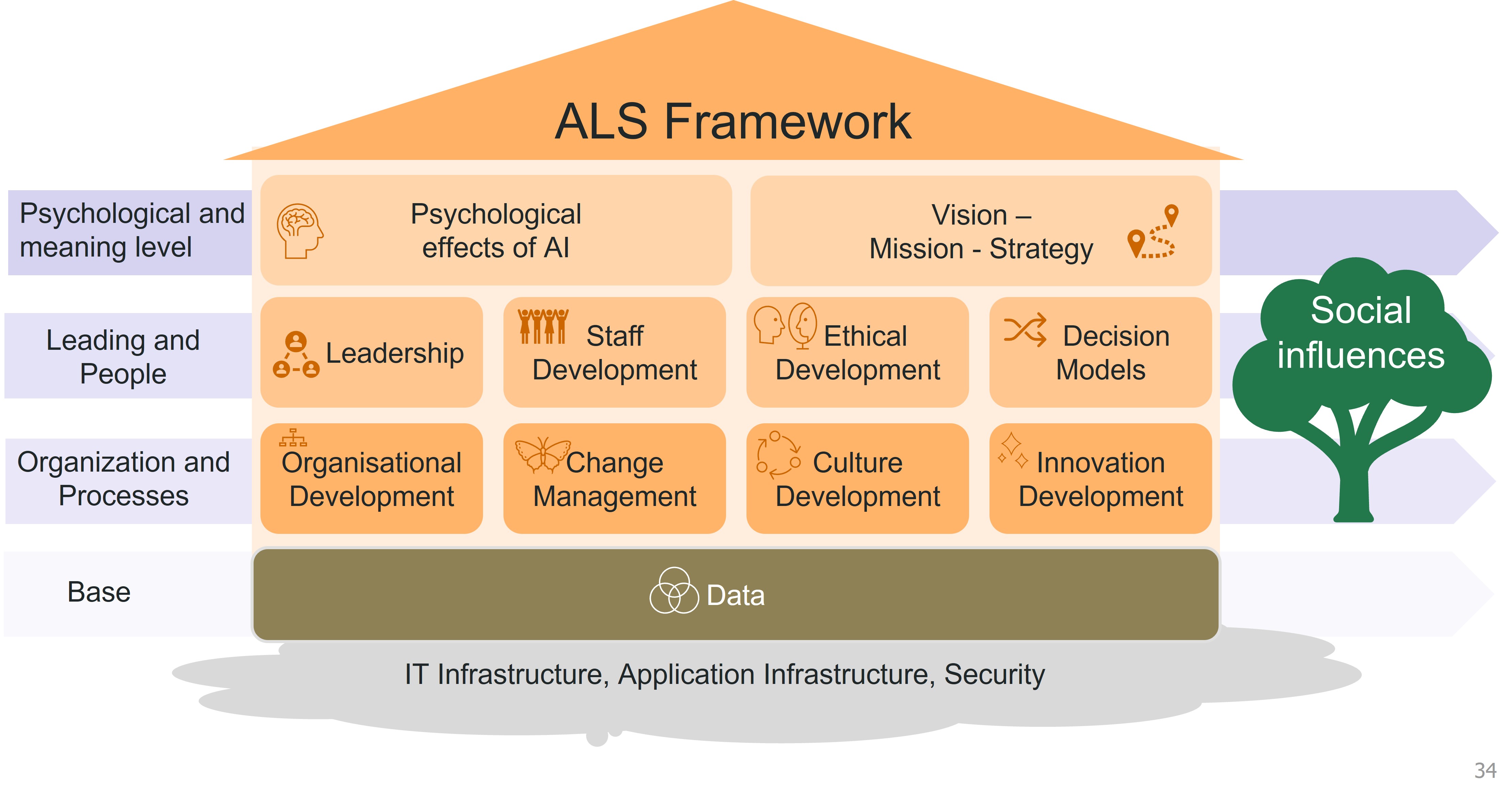
ALS (AI Leadership Symbiosis) is not a technical framework, but rather a leadership approach. At its core is the question of how humans and AI can make decisions together without losing responsibility.
The model shows how human judgement, collective intelligence and algorithmic systems can work together. This creates a form of leadership that is not based on control, but on awareness, relationships and maturity.
The framework makes visible:
Leadership, development, culture, ethics, innovation and data do not exist side by side, but rather interact with one another – and it is precisely this interaction that gives an organisation the ability to use AI responsibly, effectively and humanely.
The three levels of the ALS model
1. The human perspective
Ethics, perception, reflection and interpersonal skills.
Leadership always begins with people – in their clarity, attitude and presence.
2. The organisational perspective
Culture, structures, decision-making logic and cooperation.
AI is only as effective as the culture in which it is embedded.
3. The digital perspective
Data quality, transparency, algorithms and generative systems.
Technology provides patterns – but meaning and direction remain human.
Symbiosis arises where these three levels are consciously connected.
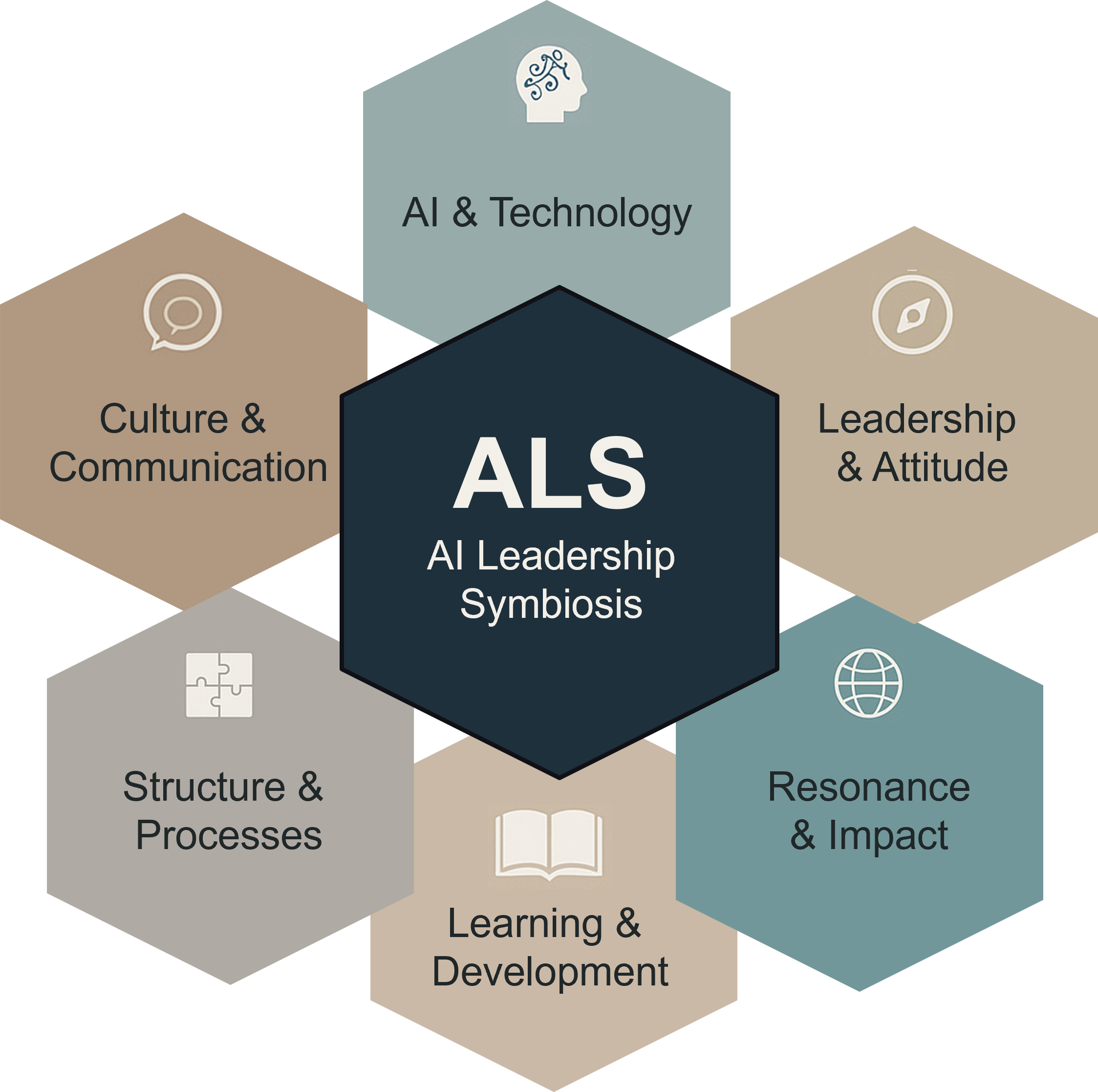
These three levels are reflected in the six fields of action of the ALS – from attitude and communication to structures and learning to technology and impact.
Why AI leadership is essential today
Organisations operate in an environment consisting of:
- increasing complexity
- faster technological change
- uncertain markets
- new ethical requirements
- accelerated decision-making cycles
In this dynamic environment, leadership is needed that is not only faster but also more mature.
ALS provides the framework for this – clear, responsible and implementation-oriented.
The core principles of the ALS approach
- Make conscious decisions instead of acting reflexively
- Remaining responsible, even when systems are involved
- Shaping culture as a sounding board for AI
- Tolerating ambiguity and providing guidance
- Using technology in dialogue – AI as a sparring partner
- Long-term value creation instead of short-term efficiency
These principles lead to leadership that remains human – especially in a technologised world.
ALS fields of application
- strategy development
- HR, Talent- & Leadership-Entwicklung
- Team dynamics & collaboration
- Change processes & transformation
- Innovation processes with AI
- Decision architectures (human–AI decision symbiosis)
- Governance, ethics & responsibility design
Benefits for your organisation
- Higher quality decision-making
- More mature leadership culture
- Responsible use of AI
- More resilient teams
- Clear roles and responsibilities when dealing with AI
- Productive collaboration between humans and systems
- Sustainable value creation
My offer
AI Leadership Consulting
Supporting organisations in the integration of AI – culturally, strategically and ethically sound.
Executive Sparring
Personal leadership clarity, decision-making support and reflection spaces for managers.
Workshops & Keynotes
Inspiration, in-depth analysis and dialogue on leadership, AI, responsibility and organisational maturity.
Diagnostics & Maturity Models
Proprietary ALS tools for analysing culture, decision-making logic and human-AI interactions.

Roland Bartl Andreoli
Author of "ALS – AI Leadership Symbiosis" and consultant for leadership, culture and artificial intelligence.
I combine systemic thinking, philosophical depth and modern AI technologies to create a new understanding of leadership in the age of intelligent systems.