Grow2Flow | AI Leadership Symbiosis
  • Home
  • Services
  • AI Leadership
  • About Grow2Flow
  • Contact
  • Blog
Sign In

Select your language

  • English (United Kingdom)
  • Deutsch (Deutschland)
The Next Generation of AI Leadership

The Next Generation of AI Leadership

Roland Bartl Andreoli Blog 23 February 2026

The next generation of leadership will not be chosen for charisma alone, nor for operational excellence in a stable world. It will be chosen for its capacity to think, decide and act in symbiosis with artificial intelligence. This is the central thesis behind the ten capabilities of AI Leadership as outlined in the framework of AI Leadership Symbiosis.

We are entering an era in which intelligence is no longer the sole preserve of humans. Algorithms analyse, predict and recommend. Systems learn. Data speaks for itself. Yet responsibility remains deeply human. It is in this tension between augmentation and accountability that a new form of leadership emerges. It is neither technocratic nor romantic. It is relational. It is systemic. It is ethical. It is symbiotic.
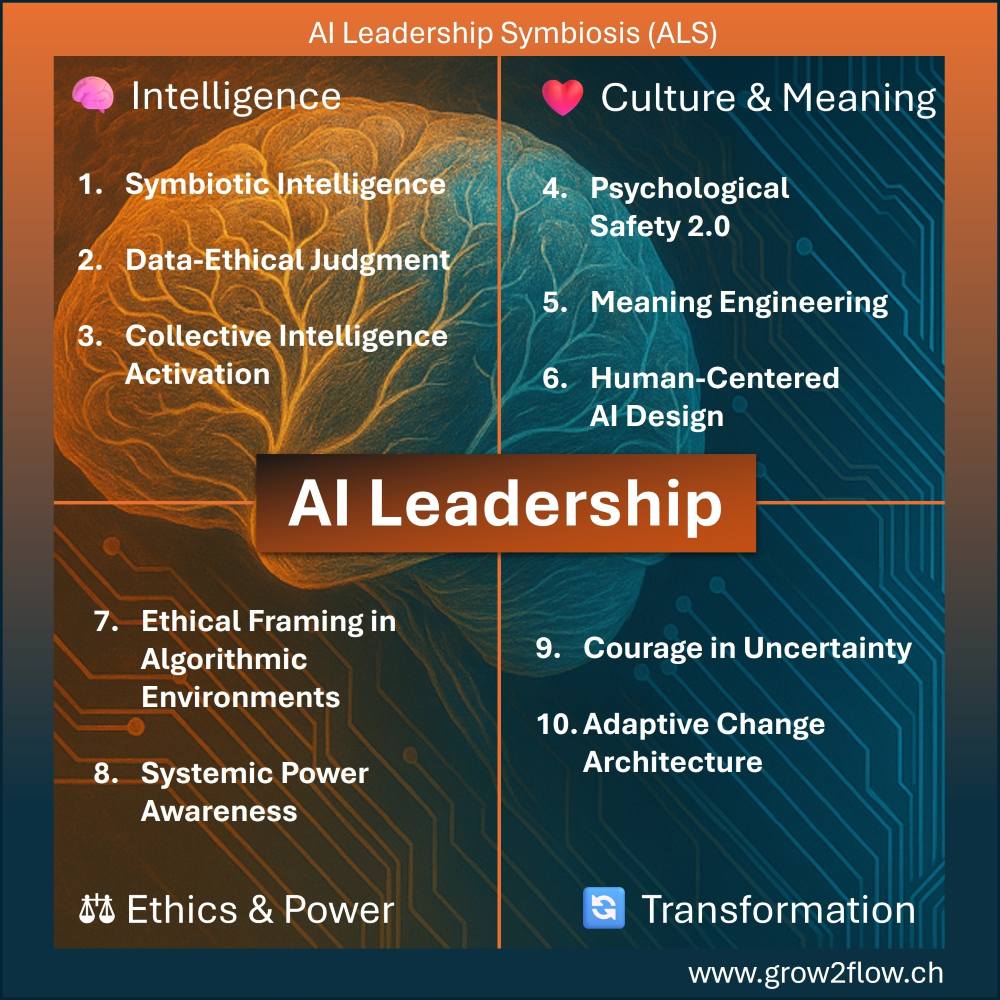
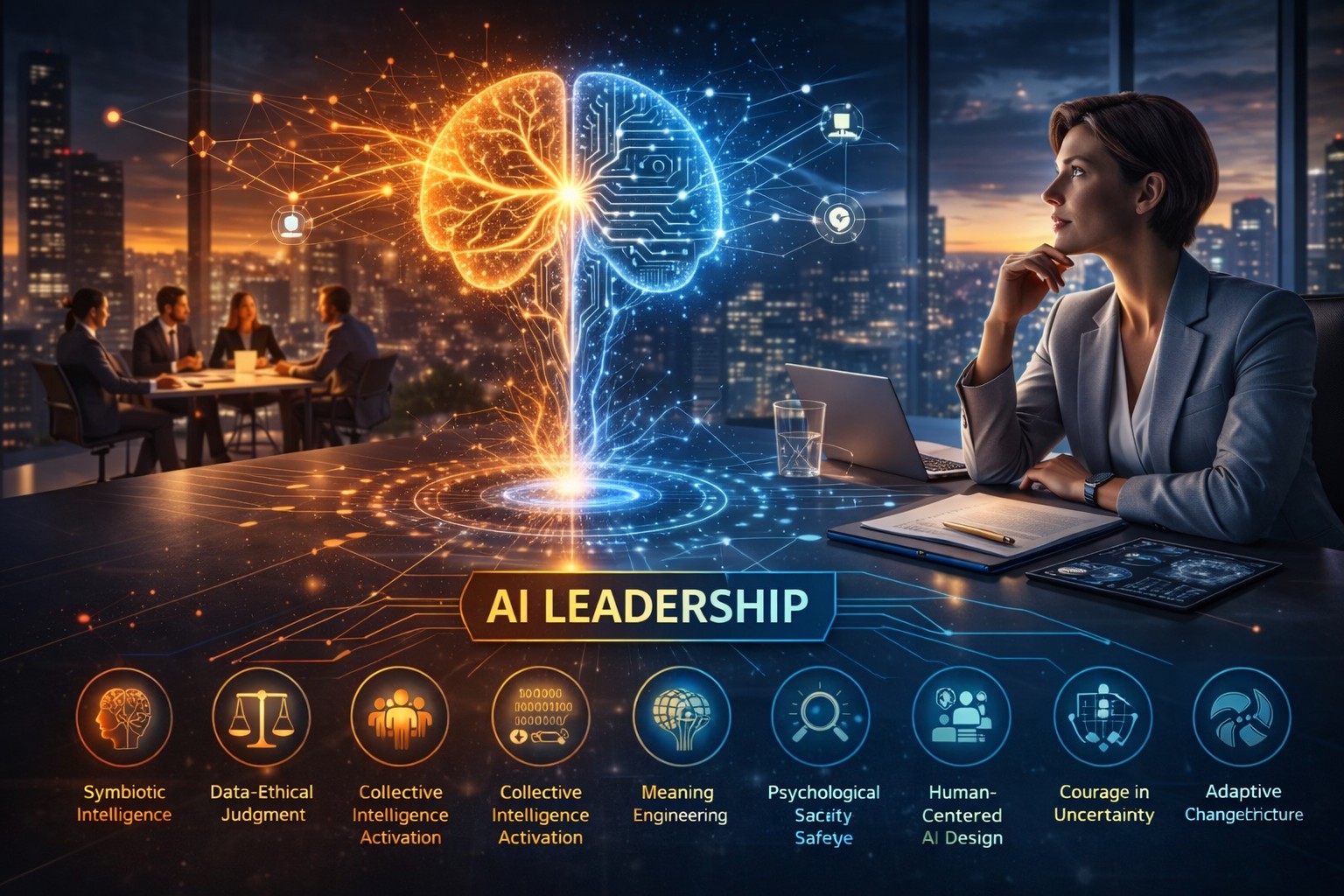
AI Leadership Symbiosis Competences

Symbiotic intelligence marks the beginning of this shift. Leadership moves from authority to augmentation. Decisions are no longer made in isolated egos but in hybrid systems in which human judgment and artificial pattern recognition interact. The leader of the future orchestrates this interaction consciously. She understands that AI is not a tool at the margins but a cognitive partner within the decision architecture of the organization. The question is no longer who decides but how decision systems are designed.

With this orchestration comes responsibility for data ethical judgment. Beyond data fluency lies data conscience. It is not enough to read dashboards and interpret correlations. Leaders must reflect on the origin of data, on distortions, on embedded biases and on downstream consequences. Bias management becomes a management task. Ethical literacy becomes strategic literacy. In the ALS perspective this is not an add on. It is a core capability because data shapes reality long before decisions become visible.

Collective intelligence activation extends the horizon further. AI can amplify not only efficiency but resonance. Used wisely it opens spaces for shared reflection, distributed sensing and co creation. The shift is from individual brilliance to systemic resonance. AI becomes a medium that connects perspectives rather than a mechanism that centralizes control. In this sense AI Leadership Symbiosis understands technology as a catalyst for collective learning rather than a substitute for human dialogue.

Culture is transformed as well. Psychological safety evolves into what can be called Psychological Safety 2.0. Trust is no longer built only between people but also in the way algorithmic systems are introduced and governed. Transparency becomes a management tool. Leaders must explain not only their intentions but also the logic of the systems that inform their decisions. Without transparency hybrid teams fracture. With transparency they mature.

Meaning engineering addresses a deeper layer. As AI takes over repetitive and cognitively demanding tasks it relieves pressure but also destabilizes identities. Work changes. Roles dissolve. Narratives are questioned. Leadership therefore provides direction, dignity and narrative embedding. It interprets transformation in a way that preserves human significance. Meaning does not arise automatically from efficiency. It must be consciously cultivated.

Human centered AI design follows from this anthropological stance. Technology follows anthropology, not the other way around. Leaders shape the implementation of AI in participatory ways. They design systems with an awareness of human complexity, vulnerability and aspiration. In the ALS model this design attitude reflects a broader commitment to aligning technological progress with human development rather than subordinating people to optimization logics.

Ethical framing in algorithmic environments becomes indispensable. Not everything that can be optimized should be optimized. Decision spaces are shaped normatively whether we acknowledge it or not. Here discourse matters more than dashboards. Habermas becomes more relevant than KPIs. Leaders must be capable of articulating the values embedded in algorithmic architectures and of facilitating discourse about them. AI Leadership Symbiosis situates leadership within communicative rationality, not merely instrumental rationality.

Systemic power awareness sharpens the lens. Power shifts through data. Visibility creates influence. Algorithms privilege certain metrics and silence others. Leaders who fail to see these invisible structures become unwitting executors of hidden agendas. Leaders who recognize them can consciously shape them. In a data driven world power is architectural. It is encoded in systems long before it is exercised in meetings.

Courage in uncertainty remains profoundly human. AI provides probabilities, simulations and forecasts. It reduces ambiguity but never eliminates it. Decisions must still be taken without full clarity. Responsibility cannot be automated. Courage remains non automatable. In the ALS perspective courage is not recklessness but the willingness to assume accountability in hybrid constellations of intelligence.

Finally adaptive change architecture reframes transformation itself. Change is no longer managed as a temporary disruption. It becomes a permanent design condition. Organizations evolve into learning systems in which AI functions as a co sensor, continuously detecting patterns and anomalies. Leadership designs the architecture within which adaptation becomes normal. Stability arises not from rigidity but from dynamic coherence.

All ten capabilities form an integrated field. Intelligence, culture and meaning, ethics and power, transformation. They are not isolated competencies but dimensions of a new leadership paradigm. AI Leadership Symbiosis proposes that the future of leadership lies in consciously shaping the interplay between human and artificial intelligence in service of human flourishing and organizational resilience.

In service of the question remains the guiding attitude. In a world where intelligence is no longer exclusively human how can we lead responsibly, ethically and effectively.

This question does not seek quick answers. It seeks reflective practitioners, courageous decision architects and systemic thinkers.

AI Leadership Symbiosis is an invitation to develop these capabilities deliberately. It is not about replacing leaders with algorithms. It is about elevating leadership to a level where human and artificial intelligence co create value, meaning and direction together.

AI and the Silent Identity Crisis of Leaders

AI and the Silent Identity Crisis of Leaders

Roland Bartl Andreoli Blog 22 January 2026

Why AI does not make leadership easier – only more honest

Leadership used to be exhausting in a very particular way. You were expected to make decisions. To know. You were expected to be the final authority in the room, even when you weren't entirely sure why.

Artificial intelligence was announced as a great relief. Finally, here was something that would analyse faster, forecast better and perhaps spare leaders from making at least a few uncomfortable decisions.

This expectation was understandable.
It was also wrong.

AI does not change the amount of leadership work, but its nature. This is precisely why so many leaders are currently experiencing a quiet identity crisis that is rarely named and almost never addressed openly.

It's quiet because nobody wants to admit it. 
It's a crisis because something fundamental no longer fits.

For decades, leadership identity was built on a simple, rarely questioned equation: I decide, therefore I lead.

Even participatory leadership models never completely dispelled this logic. They embellished it, softened it and moralised it, but left the core untouched. Someone still had to have the final say. Ideally, this would be the smartest person in the room. Or at least the person who appeared to be.

AI is deeply unimpressed by this arrangement.

In an ALS (AI Leadership Symbiosis) context, where human and artificial intelligence work together to make decisions, leaders are no longer the only source of insight. AI can propose options, identify patterns, question assumptions and occasionally produce suggestions that are disturbingly reasonable.

This is where the discomfort begins.

Not because leaders suddenly have nothing to do.
But because they can no longer define themselves primarily through decision ownership.

There is a widespread misconception that AI “takes tasks away” from leaders.
In practice, it mainly takes excuses.

Yes, AI can handle analytical workloads. It processes data, simulates futures and makes decisions with a diligence that humans cannot sustain for long. However, responsibility remains - and grows.

Ultimately, someone has to decide how AI is used, where its recommendations apply, when they should be disregarded, and why a particular course of action was chosen. Someone has to be held accountable when things go wrong. Inconveniently, that someone is still called 'leadership'.

The difference is this: Leaders are no longer responsible because they control everything, but despite the fact that they don’t.

This is not a technical challenge. It is an existential one.

Many leaders respond with admirable creativity. Some embrace AI enthusiastically, while continuing to make the same decisions as before, only faster and with more appealing presentations. Others outsource responsibility to governance frameworks, compliance departments or ethics committees, in the hope that accountability might also be automated at some point. A few retreat into vague statements about 'the human factor', which sounds profound but usually means 'don't threaten my authority'.

None of this is malicious. It is defensive.

Because ALS requires leaders to answer a question that leadership education rarely prepared them for: Who am I, if I am no longer the primary source of answers - but still fully responsible for outcomes?

In this sense, ALS is not a leadership efficiency model. It is a maturity test.

Leadership shifts from decision supremacy to something far less glamorous yet far more demanding: maintaining the system. This involves creating conditions in which good decisions can emerge, be challenged, corrected and explained. It means absorbing uncertainty without compensating for it through control theatre. It means accepting that authority is no longer derived from 'being right', but from being accountable for the process of achieving it.

This is harder work.
And it is far less ego-friendly.

Which is why the identity crisis remains mostly silent.

The irony is that this crisis is not a flaw of the AI Leadership Symbiosis.
It is its prerequisite.

Without it, ALS becomes cosmetic. AI becomes an accessory. Leadership becomes performance.

Something shifts with it. Authority becomes quieter yet firmer. Responsibility becomes explicit rather than symbolic. And, perhaps for the first time, leadership stops pretending that certainty was ever part of the job.

AI does not make leadership smaller. It makes it more honest.

And honesty, as it turns out, is a heavier responsibility than any dashboard.

Irritation statt Euphorie

Irritation statt Euphorie

Roland Bartl Andreoli Blog 08 January 2026
In vielen Teams beginnt die KI-Einführung nicht mit Neugier, sondern mit einem leisen inneren Rückzug.

Ein neues Tool wird freigeschaltet. Ein Workshop durchgeführt. Eine Präsentation gehalten.

Und trotzdem bleibt etwas hängen, das selten offen ausgesprochen wird:

  • „Was bedeutet das für meine Rolle?“
  • „Werde ich hier gerade ersetzt – oder beobachtet?“
  • „Darf ich mir noch Zeit lassen?“

Was folgt, ist keine Ablehnung von KI. Sondern Irritation.

Und Irritation ist kein Widerstand – sie ist ein Signal, dass etwas Relevantes berührt wurde.

Die unsichtbare Phase jeder KI-Einführung

In der Praxis sehe ich fast immer dieselbe Abfolge:

Phase 1: Irritation

KI taucht auf, bevor ein gemeinsames Verständnis da ist. Unsicherheit wird rationalisiert oder verdrängt.

Phase 2: Anpassung

Teams funktionieren weiter – aber defensiver. KI wird getestet, ohne wirklich integriert zu sein.

Phase 3: Koexistenz

Einige nutzen KI intensiv, andere kaum. Es entstehen stille Brüche im Team.

Was fast immer fehlt, ist der bewusste Übergang zu dem, was ich Co-Agency nenne:

Mensch und KI handeln nicht nebeneinander – sondern in geteilter Verantwortung, mit klaren Rollen.

Die Journey: From Irritation to Co-Agency

Eine tragfähige KI-Einführung ist keine Schulung. Sie ist eine soziale Lernreise.

In meiner Arbeit mit Teams hat sich dafür eine 4–6-wöchige Journey bewährt:

1. Wahrnehmen statt überzeugen

Am Anfang steht keine Strategie, sondern eine Frage:

Wie erlebt ihr KI gerade – ehrlich?

Kurze, regelmäßige TrustPulse-Formate machen sichtbar:

  • Unsicherheit
  • Erwartungen
  • leise Hoffnungen

Nicht anonymisiert „für das Management“, sondern als kollektive Standortbestimmung.

Psychologische Sicherheit entsteht nicht durch Beruhigung, sondern durch Gesehen-Werden.

2. Resonanz verstehen

Warum erzeugt KI bei manchen Sinn – bei anderen Widerstand oder Überforderung?

Die Resonanz-Treiber-Matrix hilft Teams zu erkennen:

  • Wo KI entlastet
  • Wo sie irritiert
  • Wo sie (noch) überfordert

Ohne Pathologisierung. Ohne Reifegrad-Shaming.

Widerstand ist hier kein Problem – sondern Information.

3. Lernen aus Irritation

Statt „Was lief gut / schlecht?“ lautet die zentrale Frage:

Was hat irritiert – und was hat befähigt?

Diese Lernschleifen verschieben den Fokus:

  • weg von Tool-Bewertung
  • hin zu Arbeitsrealität und Beziehung

KI wird nicht optimiert, sondern eingeordnet.

4. Kleine Experimente – kein Big Bang

Am Ende steht kein Rollout, sondern ein Action Board:

  • kleine Experimente
  • klare Verantwortungen
  • kurze Feedbackzyklen

KI agiert hier bewusst als Sparring-Partner, nicht als Entscheider.

Das verändert die Haltung: von „Ich muss mithalten“ zu „Ich kann gestalten“.

Was am Ende entsteht

Nach 4–6 Wochen passiert oft etwas Entscheidendes:

  • Gespräche werden offener
  • Nutzung wird bewusster
  • Verantwortung wird geteilt

Nicht jede Unsicherheit verschwindet. Aber sie wird besprechbar.

Das ist der Punkt, an dem Co-Agency beginnt.

Für wen das relevant ist

Diese Journey richtet sich an:

  • Teams, die KI nicht nur einführen, sondern integrieren wollen
  • Führungskräfte, die psychologische Sicherheit ernst nehmen
  • Organisationen, die Transformation ohne Zynismus gestalten wollen

Nicht als Blaupause. Sondern als strukturierter Möglichkeitsraum.

KI verändert nicht nur Prozesse. Sie verändert, wie wir uns als wirksam erleben.

Die entscheidende Frage ist nicht: „Welche Tools nutzen wir?“

Sondern: „Wie lernen wir, gemeinsam mit KI handlungsfähig zu werden?“

Wenn dich diese Journey anspricht oder du spürst, dass dein Team gerade irgendwo zwischen Irritation und Anpassung festhängt, lass uns ins Gespräch kommen. Ich habe mit meinem AI Leadership Symbiosis Framwork vielleicht eine Antwort.

Nicht für eine Lösung. Sondern für ein gemeinsames Verstehen.

Viele KI-Einführungen scheitern nicht an Technologie, sondern an unausgesprochenen Irritationen.
The ROI of Symbiotic Leadership: How the ALS Model Unlocks Revenue, Trust, and Innovation in the Age of AI

The ROI of Symbiotic Leadership: How the ALS Model Unlocks Revenue, Trust, and Innovation in the Age of AI

Roland Bartl Andreoli Blog 05 December 2025

AI-driven leaders outperform traditional leaders by up to 37% in revenue growth—but only when human and machine intelligence operate in true partnership (Florea & Croitoru, 2025; Zárate-Torres et al., 2025).
This performance gap signals a profound shift: leadership effectiveness is no longer defined solely by human skill, but by a leader’s ability to orchestrate a hybrid system of human judgment and artificial intelligence.

Classic leadership theories were never designed for a world where algorithms co-shape decisions, workflows, and even team culture. Yet AI is already transforming leadership practice. It enhances decision accuracy, improves detection of risks, accelerates strategic execution, and provides leaders with new forms of insight unavailable through human cognition alone (Glikson & Woolley, 2020). But the story does not end with efficiency gains. AI also introduces new ethical demands, new relational dynamics, and new abilities to harness collective intelligence at scale (Uddin, 2023).

To address this paradigm shift, the ALS Model (AI Leadership Symbiosis) introduces three leadership styles that did not exist before the rise of AI: AI-Augmented Leadership, Data-Ethical Leadership, and Collective Intelligence Leadership. Together, these styles create measurable financial ROI while simultaneously strengthening organizational culture, trust, and resilience.

AI-Augmented Leadership: Precision, Speed, and Better Strategic Outcomes

AI-Augmented Leadership describes leaders who deliberately partner with AI systems to co-create decisions.
Research shows that leaders who integrate AI into their strategic processes improve decision accuracy, shorten planning cycles, and reduce operational blind spots (Florea & Croitoru, 2025). AI helps leaders simulate outcomes, test scenarios, detect patterns, and uncover risks that humans overlook.

Organizations applying AI-augmented decision-making have demonstrated:

  • 6–12% higher revenue, driven by faster time-to-market

  • Reduced operational error rates due to data-supported decisions

  • Improved strategic alignment, because AI reveals gaps in execution

Yet the value of AI-Augmented Leadership is not only rational but relational: leaders free cognitive capacity and gain time to spend on creativity, communication, and culture.

The result is a leadership practice that is both more analytical and more human.

Data-Ethical Leadership: The New Moral Compass of the Digital Enterprise

While AI offers powerful capabilities, it also magnifies ethical risks—bias, opacity, discrimination, and privacy concerns.
Data-Ethical Leadership ensures that AI enhances organizational values instead of undermining them. Leaders apply fairness, transparency, and accountability to all algorithmic decision processes (Uddin, 2023).

Evidence shows that ethical AI practices create tangible ROI:

  • 3–7% revenue growth through increased stakeholder trust and reduced compliance risk

  • Higher employee engagement, as people feel protected rather than monitored

  • Stronger employer branding, especially among younger generations

Ethical leadership also reduces the long-term hidden costs of AI mismanagement, such as reputational damage or legal exposure. In other words, ethics is not a constraint—it is an economic multiplier.

Collective Intelligence Leadership: The Highest ROI of All

The most transformative ALS style is Collective Intelligence Leadership, which merges the strengths of humans and machines into a hybrid decision system stronger than either alone.
AI aggregates knowledge, identifies trends, and connects information across silos, while humans contribute contextual understanding, intuition, and values (Zárate-Torres et al., 2025).

Studies show that hybrid human–AI systems outperform purely human or purely machine-based teams in innovation, forecasting, and complex problem-solving.

Organizations that deliberately combine human and machine intelligence see:

  • 8–18% higher revenue, driven by superior innovation

  • Increased solution quality, as biases are corrected through hybrid thinking

  • Higher adaptability, because AI and human teams learn faster together

This is not merely an operational change—it is a cultural one. Leaders shift from being directors of work to becoming curators of intelligence.

Beyond Efficiency: The Real ROI of the ALS Leadership Paradigm

Most conversations about AI and leadership focus on efficiency—automation, cost reductions, or performance improvements. Yet efficiency is only the first wave of the new AI-enabled economy.

The deeper ROI of ALS Leadership emerges in four areas:

1. Trust Capital

Employees trust leaders who use AI transparently and ethically. Trust accelerates adoption, reduces resistance, and strengthens collaboration.

2. Innovation Capacity

When AI handles analysis, leaders and teams gain space to imagine, explore, and create.

3. Organizational Resilience

AI-supported leaders detect disruptions earlier, respond faster, and adjust strategies with higher precision.

4. Human Meaning and Purpose

Paradoxically, the more AI enters organizations, the more employees seek meaning and human connection.
ALS Leadership restores the leader’s role as sense-maker, mentor, and ethical anchor.

Thus, the ROI of the ALS Model is both tangible (revenue, efficiency, innovation) and intangible (trust, culture, purpose). Both dimensions are necessary for long-term success.

Conclusion: The Leadership Question of the AI Era

As AI becomes a silent partner in every decision, leaders must ask themselves:

Which of my leadership styles does AI already amplify—and which must I consciously strengthen so that none are overshadowed?

AI will reinforce your leadership habits.
It will compensate for your weaknesses.
And it may already understand your leadership style better than you do.

The ALS Model empowers leaders to lead with awareness rather than autopilot. By cultivating AI-Augmented, Data-Ethical, and Collective Intelligence Leadership, organizations unlock not only new revenue streams but also new forms of human value.

Symbiotic leadership is not the future—it has already begun.


References

Florea, N. V., & Croitoru, G. (2025). Artificial intelligence and leadership: A review of hybrid decision-making in organizations. Administrative Sciences, 15(2), 33.

Glikson, E., & Woolley, A. W. (2020). Human trust in artificial intelligence: Review of empirical research. Academy of Management Annals, 14(2), 627–660.

Uddin, A. (2023). Ethical challenges in AI-supported leadership: A review. Open Journal of Leadership, 12(4), 400–417.

Zárate-Torres, R. A., et al. (2025). Hybrid human–AI collaboration and the moderating role of leadership behavior. Behavioral Sciences, 15(7), 873.

Warum klassische Führungsrollen scheitern und Resonanz-Coaching im KI-Zeitalter entscheidend wird. Moderne Leadership neu gedacht.

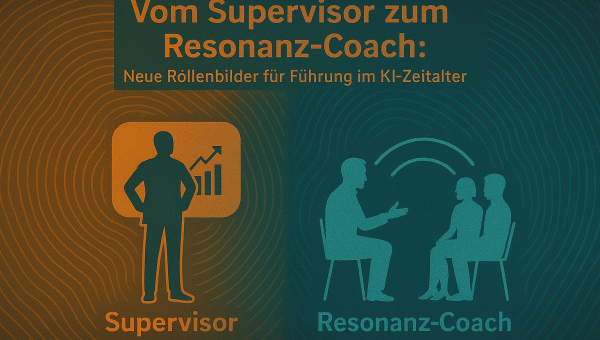
Vom Supervisor zum Resonanz-Coach: Warum moderne Führung im KI-Zeitalter neue Rollenbilder braucht

Roland Bartl Andreoli Blog 04 December 2025

Wenn wir heute über Führung sprechen, wirken viele Begriffe wie aus einer anderen Epoche. Supervisor. Manager. Vorgesetzter. Sie stammen aus einer Zeit, in der Organisationen wie Maschinen gedacht wurden: planbar, steuerbar, berechenbar. Es war ein übersichtliches Modell – ein Mensch oben, viele Menschen darunter. Doch diese Welt existiert so nicht mehr. Sie wurde überholt von Dynamik, Komplexität, Unsicherheit und einer Technologie, die nicht nur Aufgaben verändert, sondern Denkweisen.

Künstliche Intelligenz verschiebt das Verhältnis von Wissen und Führung. Wo früher Informationsvorsprünge Macht erzeugten, kann heute fast jeder – und jede Organisation – Wissen in Echtzeit generieren. Das stellt klassische Führungsrollen infrage. Denn wenn Expertise nicht mehr exklusiv ist, verliert das Kontrollieren seinen Sinn. Der Supervisor wird zu einem Relikt, das die Anforderungen der Gegenwart nicht mehr abbildet.

Moderne Führung braucht ein anderes Rollenverständnis. Eines, das Beziehung, Bewusstsein und Reflexion ins Zentrum stellt. In diesem Kontext taucht ein Begriff auf, der in der Führungstheorie lange gefehlt hat: Resonanz. Er stammt ursprünglich von Hartmut Rosa, der Resonanz als eine gelingende Weltbeziehung beschreibt – ein In-Kontakt-Sein mit sich selbst, anderen und der Umwelt, das nicht auf Kontrolle, sondern auf Responsivität basiert. Übertragen auf Führung bedeutet das: Wirksamkeit entsteht dort, wo Führungskräfte Beziehungen ermöglichen, nicht nur Prozesse managen.

Warum der Supervisor an seine Grenzen kommt

Der Supervisor operiert aus einer Logik der Bewertung. Er schaut von oben auf ein System und versucht, es zu steuern. Doch sobald Komplexität im Spiel ist – oder KI – wird diese Sicht unzureichend. KI liefert Daten, Muster, Prognosen. Sie liefert Geschwindigkeit. Aber sie liefert keine Resonanz. Sie kann analysieren, aber nicht zuhören. Sie kann Muster erkennen, aber keine Beziehung herstellen.

Damit verschiebt sich die zentrale Frage in der Führung:
Wie entsteht Vertrauen in einer Welt, in der Maschinen immer mehr wissen – aber nichts fühlen?

Das klassische Rollenmodell gibt darauf keine Antwort. Der Resonanz-Coach hingegen schon.

Der Resonanz-Coach als Rollenbild der Zukunft

Ein Resonanz-Coach ist keine weichgezeichnete Version eines Chefs. Er ist eine Führungskraft, die verstanden hat, dass Wirksamkeit nicht mehr über Kontrolle hergestellt wird, sondern über Beziehung und Bewusstsein. Der Resonanz-Coach führt nicht lauter oder dominanter. Er führt klarer.

Er arbeitet mit drei Dimensionen:

1. Bewusstsein:
Er versteht, was KI kann – und was nicht. Er achtet darauf, wie Menschen Entscheidungen treffen, wie Maschinen sie unterstützen und wie beides zusammenwirkt.

2. Beziehung:
Er schafft Räume, in denen Menschen sich zeigen können, ohne ständig bewertet zu werden. Räume, die Sicherheit und Orientierung geben, gerade wenn sich alles schnell verändert.

3. Integration von KI:
Er nutzt KI nicht als Abkürzung, sondern als Spiegel. Er sieht in den Daten nicht die Wahrheit, sondern eine Perspektive. Menschen und KI stehen nicht im Wettbewerb, sondern in Beziehung. Erst im Zusammenspiel entsteht Führung.

Diese Haltung ist kein Luxus, sondern ein notwendiges Update im Führungsbetriebssystem.

Was KI mit Resonanz zu tun hat – und was nicht

KI zwingt uns dazu, das zutiefst Menschliche neu zu entdecken. Empathie. Sinn. Ethik. Ambiguitätstoleranz. Früher waren das „Soft Skills“. Heute sind es Kernkompetenzen. Nicht, weil sie nett sind – sondern weil KI alles andere besser kann.

Das Paradoxe ist: Je mehr Technologie wir nutzen, desto mehr Resonanz brauchen wir.
Denn KI kann Entscheidungen vorbereiten, aber keine Beziehungen gestalten.
Sie kann Fakten liefern, aber keine Haltung entwickeln.
Sie kann sortieren, aber nicht führen.

Führung im KI-Zeitalter bedeutet deshalb nicht, Maschinen zu übertreffen, sondern mit ihnen zu kooperieren – und dort Resonanz herzustellen, wo Technologie an ihre Grenzen kommt.

Die Rolle des ALS-Modells

In der Logik der AI Leadership Symbiosis (ALS) entsteht Führung nicht mehr als einseitige Bewegung von oben nach unten, sondern als bewusst gestaltetes Zusammenspiel von Mensch und Maschine.
Der Resonanz-Coach im ALS-Modell:

  • nutzt KI für Klarheit

  • nutzt Resonanz für Orientierung

  • schafft Räume für Selbstorganisation

  • trifft Entscheidungen nicht schneller, sondern fundierter

  • führt nicht über Macht, sondern über Beziehung

Das ALS-Modell bietet damit eine Architektur, die sowohl die technische als auch die menschliche Dimension moderner Führung ernst nimmt.

Wohin sich Führung entwickelt

Vielleicht müssen wir das Wort „Führung“ neu denken. Weg von Überlegenheit. Hin zu Bewusstsein. Weg von Rollen, die auf Kontrolle beruhen. Hin zu Rollen, die auf Beziehung basieren.

Der Supervisor schützt die Ordnung der Vergangenheit.
Der Resonanz-Coach gestaltet die Möglichkeit der Zukunft.

In einer Welt, die von KI durchdrungen ist, wird genau dieser Rollenwechsel entscheidend sein:
Führung wird nicht daran gemessen, wie viel Kontrolle jemand ausübt, sondern daran, wie viel Resonanz er ermöglicht.

  1. Leadership Styles Special
  2. Wenn klassische OE an ihre Grenzen kommt – und wie AI Leadership Symbiosis den Raum erweitert
  3. Wenn KI zum Selektionsfilter der Politik wird
  4. Warum KI-Leadership ohne Haltung zum Risiko wird
Copyright © 2025 Grow2Flow | AI Leadership Symbiosis. All Rights Reserved. DE: Impressum und Datenschutz EN: Imprint and Data Policy
Grow2Flow | AI Leadership Symbiosis
  • Home
  • Services
  • AI Leadership
  • About Grow2Flow
  • Contact
  • Blog