



What kind of leader are you – or what kind do you think you are?
What happens when your AI already knows more about your leadership style than you do?
We often talk about leadership, but rarely about ourselves. After all, leadership is a role model: flexible, professional, situational. But in the age of AI and organisational acceleration, a new question arises:
Are we really still consciously in control? Or are we simply falling back into our old patterns, while AI has long since figured out how we tick?
The leadership style compass of the ALS model makes these patterns visible without judging them, but rather to create clarity:
- Which aspects of yourself really make the decisions?
- Which styles do you activate intuitively – and which ones would you need to consciously cultivate in order to lead symbiotically with AI?
The 12 Leadership Styles – your personal leadership portfolio
Leadership is not manifested in a single attitude. Leadership is a set of modules that you combine depending on the situation – especially when AI supports or challenges your decisions with data, forecasts and patterns.
In the ALS model, leadership styles are not understood as fixed categories, but as dynamic building blocks of symbiotic leadership intelligence. Each style has its strengths and risks, as well as its significance in the interplay between human judgement and AI support.
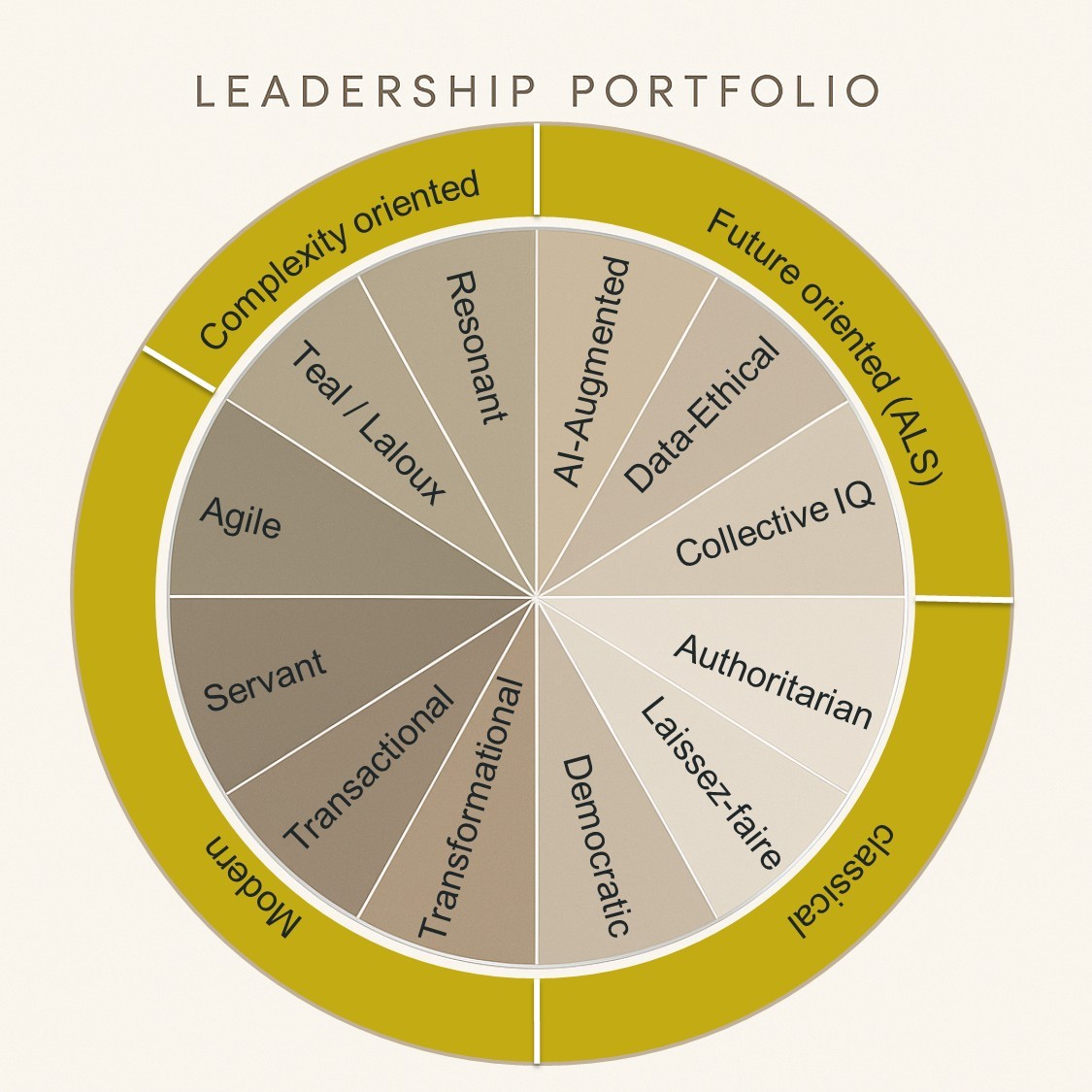
You can answer the question at the end of each of the twelve leadership styles listed below on a scale from 1 ("does not apply") to 5 ("applies strongly"). The higher your score, the more this style influences your natural leadership behaviour and the more often you intuitively activate it, especially under pressure or in complex situations. The sum of your answers does not result in a "right" or "wrong" profile, but rather shows your personal leadership portfolio, which you can consciously combine with AI. Three of the twelve styles are new and arise directly from the ALS model: AI-Augmented Leadership, Data-Ethical Leadership and Collective Intelligence Leadership. They describe forms of leadership that are made possible by the collaboration between humans and AI and expand your traditional leadership styles into a future, symbiotic practice.
|
Leadership Style |
Strengths / Benefits |
ALS-Relevance |
|
Authoritarian |
Speed, clarity, crisis resilience |
AI reinforces patterns – ethical reflection needed |
|
Laissez-faire |
Autonomy, creativity |
AI provides structure when there is a lack of orientation |
|
Democratic |
Participation, diversity of perspectives |
AI supports deliberation and scenarios |
|
Transformational |
Vision, energy, purpose |
AI grounds visions through data |
|
Transactional |
Structure, efficiency |
AI optimises goals and performance |
|
Servant Leadership |
Trust, empowerment |
AI provides team diagnostics |
|
Agile Leadership |
Adaptability, iteration |
AI prioritises and accelerates learning loops |
|
Teal / Laloux |
self-organisation |
AI creates transparency and decentralisation |
|
Resonant Leadership |
Emotion, relationship |
AI relieves the burden, but does not replace relationships |
|
AI-Augmented |
Precision, co-leadership |
New at ALS: Humans + AI as a team |
|
Data-Ethical |
Fairness, integrity |
New at ALS: Ethics in the digital space |
|
Collective Intelligence |
Hybrid Thinking |
New at ALS: Humans and machines make better decisions |
Authoritarian Leadership: Authoritarian leadership means leading with determination. Quickly, clearly, dominantly – especially in crises. AI reinforces this leadership style by providing precise diagnoses. But be careful: centralisation creates blind spots and tempts leaders to slip into "I decide everything" mode.
Question: Do I make decisions quickly – and do I need control when things get serious?
Laissez-faire Leadership: This style gives freedom – sometimes too much. It is suitable for mature teams, but carries the risk of chaos. AI compensates for this by recognising patterns before they get out of hand.
Question: How much do I trust my team – truly, without intervening?
Democratic Leadership: Democratic leadership encourages participation and strengthens teams. However, it can be slow in complex situations. AI can help to organise opinions and simulate options.
Question: Do I regularly seek input before making a decision?
Transformational Leadership: Transformational leadership stands for vision, energy and inspiration. It can inspire people – or overwhelm them. AI can underpin visions with facts.
Question: Do I inspire through purpose, vision and meaning?
Transactional Leadership: Structure. Clarity. Consistency. This style works, but it limits creativity. AI makes it smarter: clear goals, less friction, better performance analyses.
Question: How much do I need clear goals and measurable results?
Servant Leadership: The focus is on people. Empowerment instead of control. AI supports through stress analyses and talent forecasts. But the boundaries can become blurred.
Question: How important is the well-being of my team to me?
Agile Leadership: Agility is based on change and iterative learning. Without priorities, it becomes chaotic. AI creates order here, filters relevance and accelerates feedback loops.
Question: How well do I thrive in fast, flexible processes?
Teal / Laloux Leadership: Self-organisation, wholeness, evolution. A powerful approach, but one that is difficult to implement. AI creates transparency and supports decentralised decision-making logic.
Question: How much do I believe in self-organised teams – without hierarchy?
Resonant Leadership: Relationship, emotion, presence. Resonant leadership creates stability when the emotional burden is shared. AI can lighten the load, but it can never replace the relationship.
Question: How central are emotions and dialogue in my leadership style?
 |
AI-Augmented Leadership: Conscious collaboration between humans and machines. AI as co-leader, not boss. This style will shape the future. Data-Ethical Leadership: Leadership with a moral compass. Fairness, transparency, responsibility. Those who follow this style lead with integrity – especially when dealing with AI. Collective Intelligence Leadership: The style of the future is the combination of the intelligence of many people with the intelligence of machines. Artificial intelligence structures knowledge, while people contribute experience, context and values. |
Understanding ALS – What does this mean for you as a manager?
The ALS model assumes that you use several of these styles simultaneously – consciously or unconsciously. The crucial question is therefore:
Which styles do you consciously choose – and which ones does your autopilot choose?
With AI at your side, this autopilot becomes more powerful:
- AI reinforces patterns you use frequently.
- AI compensates for styles you lack.
- AI reflects how you lead – sometimes more accurately than you yourself.
ALS requires you to: Don't just lead with style. Lead with awareness.